Two days at TechEx Amsterdam confirmed it: the models are new, but the hard part is still the journey from pilot to shareholder value. Four takeaways on shadow AI, governance and running AI in production.
New technology, same problem
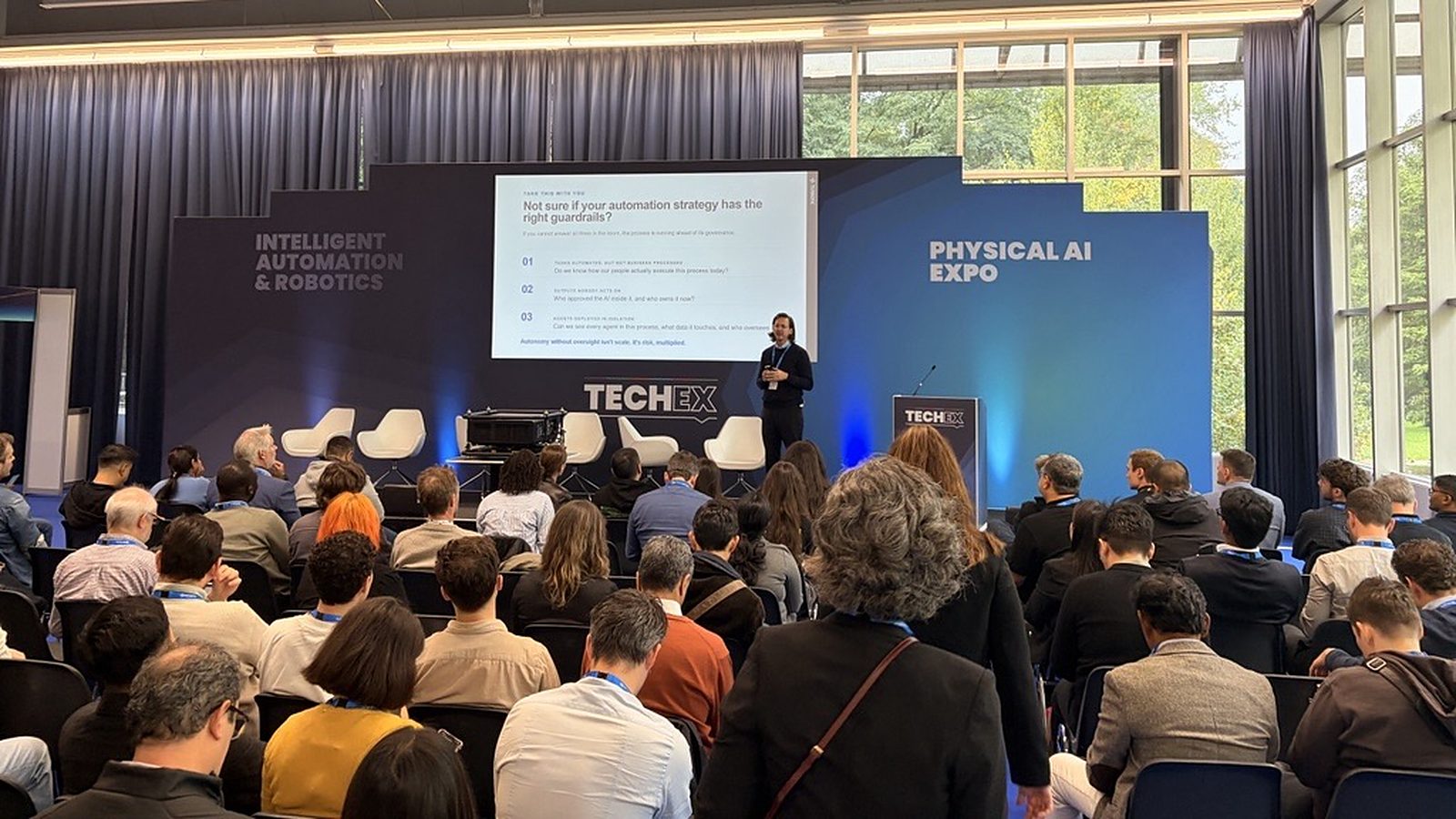
I spent two days at TechEx in Amsterdam, listening to companies talk about how they are putting AI to work. The technology on stage was new. The problem behind it was not.
Every wave of automation I have worked with, from RPA to process mining to low-code, has eventually hit the same wall: how do you take a promising technology and implement it so it actually creates value for shareholders? AI is no different. The models are better than ever, but the hard part is still the journey from pilot to shareholder value.
And there is a clock ticking. 88% of UK organisations have shadow AI: employees using AI tools the company has not approved. I doubt the Nordics look very different. People are not waiting for the official roadmap, which makes speed of implementation a governance question, not just a business one.
That tension, between the need for speed and the reality of slow implementation, ran through the whole conference. Here are four things I took home.
Four things I heard at TechEx
1. Shadow AI is everywhere, but hardly on the agenda
Employees are already using AI on their own, often with company data. Yet shadow AI was barely mentioned as a concern. Every month a company waits for the perfect implementation, its people find their own shortcuts.
2. Models get better fast. Implementation does not.
Model capability improves month by month, but aligning with process owners, IT and compliance takes as long as it always has. Most companies still implement AI one use case at a time, not end to end. And when I listened for a recipe for moving faster, I did not hear one.
3. Governance, security and data access still block scaling
The pilot works. Then someone asks who owns the data, who approved the model and how it is monitored. That is where many initiatives stall, and our UK research shows governance is the number one barrier keeping AI stuck in pilot. Governance is essential, but when it only slows things down, it pushes people towards shadow AI.
4. Building is easy. Running is not.
With tools like Lovable, anyone can build an application in an afternoon. But how do you make sure it works in production, stays up and is supported when the builder moves on? Speed without an operating model just creates a new kind of shadow IT.
Start a conversation that leads to progress.
Connect with our team and explore solutions tailored to your needs.

The moment that stayed with me
For the first time at a conference like this, I heard a leader responsible for implementing AI speak openly about his concern for the jobs that are, and will be, affected by his own work.
It was not a disclaimer at the end of a slide. It was an honest reflection. Most of us in this industry talk about efficiency, capacity and freed-up time. Fewer of us say out loud that behind those numbers are people whose roles will change, or disappear.
I think that honesty matters. Organisations that take the human side seriously, with reskilling, transparency and clear communication, are also the ones more likely to get real adoption.
What this means for those of us implementing AI
TechEx confirmed something we see with our clients every day. The technology is rarely what holds companies back. What holds them back is everything around it: governance, data access, operations, ownership and the link to the business.
If AI is going to create value for shareholders, a few things need to change:
- Start from the core business, not the technology. Surprisingly few speakers connected AI to what their company actually sells. Pick the processes that drive revenue or cost, and design AI into them.
- Treat governance as an enabler. Clear rules for data, models and security make it possible to scale, rather than stopping at the pilot.
- Plan for production from day one. Whether it is an RPA bot, an AI agent or an app built in an afternoon, someone needs to run it, monitor it and keep it up.
- Move at the speed of your people. If approved tools take a year to arrive, shadow AI fills the gap.
- Be honest about the people. Adoption follows trust.
New technology, same problem. The companies that win with AI will not be the ones with the best models. They will be the ones that are best at implementing them.