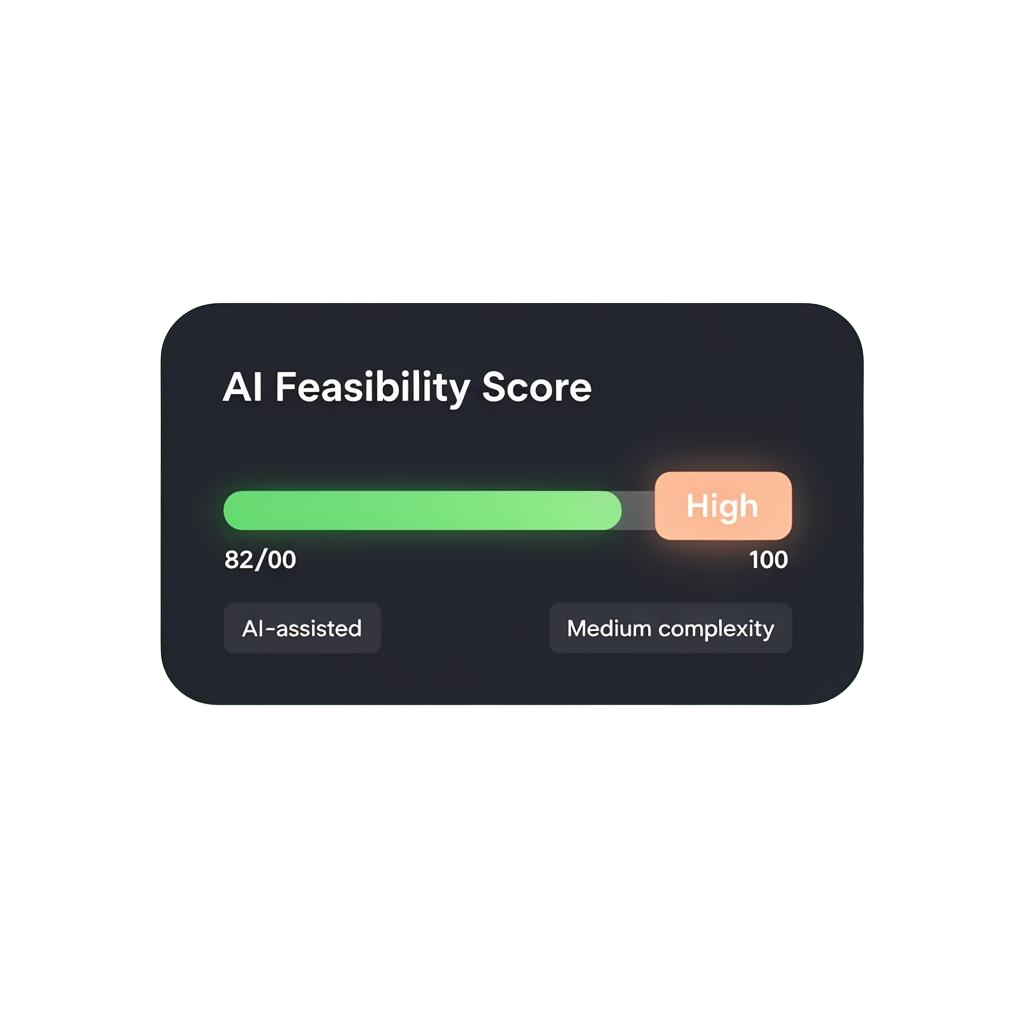

Most automation projects don't fail at the technology layer — they fail because the wrong processes were chosen. Here's how to run a proper feasibility assessment before you invest.
Most automation programmes that disappoint don't fail because the technology was wrong. They fail because the process was wrong. The bot works. The agent runs. The integration holds. And yet, six months in, the savings aren't there — because the process that got automated shouldn't have been the first one on the list.
A feasibility assessment is the discipline that prevents this. It's the difference between an automation programme that compounds and one that quietly stalls.
What a feasibility assessment actually is
A feasibility assessment is a structured evaluation of whether a specific process is a good candidate for automation — before a single line of configuration is written. It answers three questions in order: Can we automate this? Should we automate this? What will it cost us if we do?
Done well, it takes hours, not weeks. Done badly — or skipped entirely — it costs months of build time, vendor licences, and CoE credibility. The teams with the highest automation ROI almost always have the most rigorous front-end filter.
The three dimensions to evaluate
Every credible feasibility framework converges on the same three lenses. Skip any one of them and the business case is incomplete.
1. Technical viability. Is the process stable, rules-based, and digitally accessible? Are the source systems reachable via APIs or reliable UI automation? How structured is the data — clean fields, mixed documents, or free text? Technical viability sets the ceiling for what's possible.
2. Financial ROI and payback. What does the process cost today in FTE hours, error rework, and cycle time? What will it cost to build, license, and maintain the automation? A useful rule of thumb: if the payback period exceeds 12–18 months on a single process, the assumptions usually need re-examining.
3. Operational impact. What changes for the people doing the work? Which handoffs disappear, which new ones appear, and who owns exceptions when the bot can't decide? Operational impact is where most business cases quietly break — the savings are real, but the change effort to capture them was never costed.
The key questions to ask
A practical checklist, drawn from established feasibility frameworks and refined on real enterprise programmes:
- Frequency. How often does the process run — daily, weekly, monthly, occasionally? Low frequency rarely justifies a custom build.
- Volume. How many transactions, tickets, or cases per run? Volume is the multiplier on every saved minute.
- Standardisation. Are the steps the same every time, or does each case look different? Variance is the enemy of straight-through automation.
- Exception rate. What percentage of cases require human judgement today? A 5% exception rate is manageable; a 40% rate means you're automating the easy half and keeping the hard half.
- Data structure. Structured fields, semi-structured documents, or unstructured email? Each step down that ladder roughly doubles the build effort.
- Integration surface. How many systems are touched, and how are they connected today? APIs are cheap; manual file transfers and screen scraping are not.
- Stability. How often does the process change — quarterly, annually, never? Automating a process that's about to be redesigned is a write-off.
- Cost-benefit. What's the fully loaded annual cost today, what's the expected reduction, and what's the realistic build and run cost?
If a process fails on two or more of these, it doesn't mean "never." It means "not now."
The mistakes teams make over and over
Three patterns show up in almost every stalled programme:
1. No baseline metrics. Teams automate a process they've never measured, then can't prove savings. If you can't quantify the before, you can't defend the after.
2. Exception handling treated as an afterthought. The happy path gets automated; the 20% of edge cases that drive 80% of the cost get dumped back on the team. Net savings: near zero.
3. Change management skipped. The automation works, but the operating model around it doesn't change — same headcount, same handoffs, same reporting. The capacity gets reabsorbed instead of redeployed.
A feasibility assessment that doesn't surface these risks isn't an assessment. It's a wish list.
Start a conversation that leads to progress.
Connect with our team and explore solutions tailored to your needs.

How to get started quickly
You don't need a six-week consulting engagement to do this well. A structured 12-question assessment will tell you whether a process belongs in the top of the funnel, the middle, or the bin.
Turbotic's Automation Feasibility Check is a free AI-powered tool that scores any process across the dimensions above in under three minutes — frequency, complexity, exception rate, integration requirements, and expected impact. The output is a feasibility zone and a recommended approach, not a sales pitch.
Once a process clears feasibility, the next decision is how to automate it. For most enterprises, that's a combination of Automation AI for execution and an orchestration layer to govern and scale the portfolio. But that's the second conversation. The first one is whether the process belongs on the roadmap at all.
Get that question right and almost everything downstream gets easier.
Frequently Asked Questions
What is an automation feasibility assessment?
An automation feasibility assessment is a structured evaluation of whether a specific business process is a good candidate for automation, looking at technical viability, financial ROI, and operational impact before any build work begins.
What makes a process a good fit for automation?
Good candidates are high-frequency, high-volume, standardised, rules-based processes with structured data, accessible source systems, a low exception rate, and a clear, measurable cost baseline.
How long does a feasibility assessment take?
A lightweight assessment using a structured framework or tool can be completed in minutes to hours per process. Deeper analysis for complex, multi-system processes typically takes a few days.
Related Reading
- AI Workslop: The Productivity Tax Costing Enterprises Millions
- The Definitive 2026 Guide to Selecting AI Automation Solutions
- Scalable Enterprise Automation Platforms 2026
References
- Automation Project Feasibility Analysis — Number Analytics, Sarah Lee, June 2025. Technical, financial, and operational feasibility framework, including ROI calculation and payback period.