
New Turbotic research finds governance and compliance is the top barrier stopping UK businesses from moving AI beyond the pilot stage — and only 16% say they are deploying AI at scale successfully. Here's what's holding them back and how to fix it.
Building an AI pilot has never been easier. Getting it into day-to-day operations is another matter. New research from Turbotic, surveying more than 1,000 senior UK decision-makers involved in setting and assessing AI projects, found that governance and compliance is the most commonly cited barrier to moving AI beyond the pilot stage, named by 37% of businesses. Proving ROI (35%), a lack of internal AI skills (34%) and poor data quality (34%) follow close behind.
The result: only 16% of UK businesses say they are successfully deploying AI at scale.
This isn't a technology problem. It's an organisational and operational readiness problem — and it affects large businesses just as much as small ones.
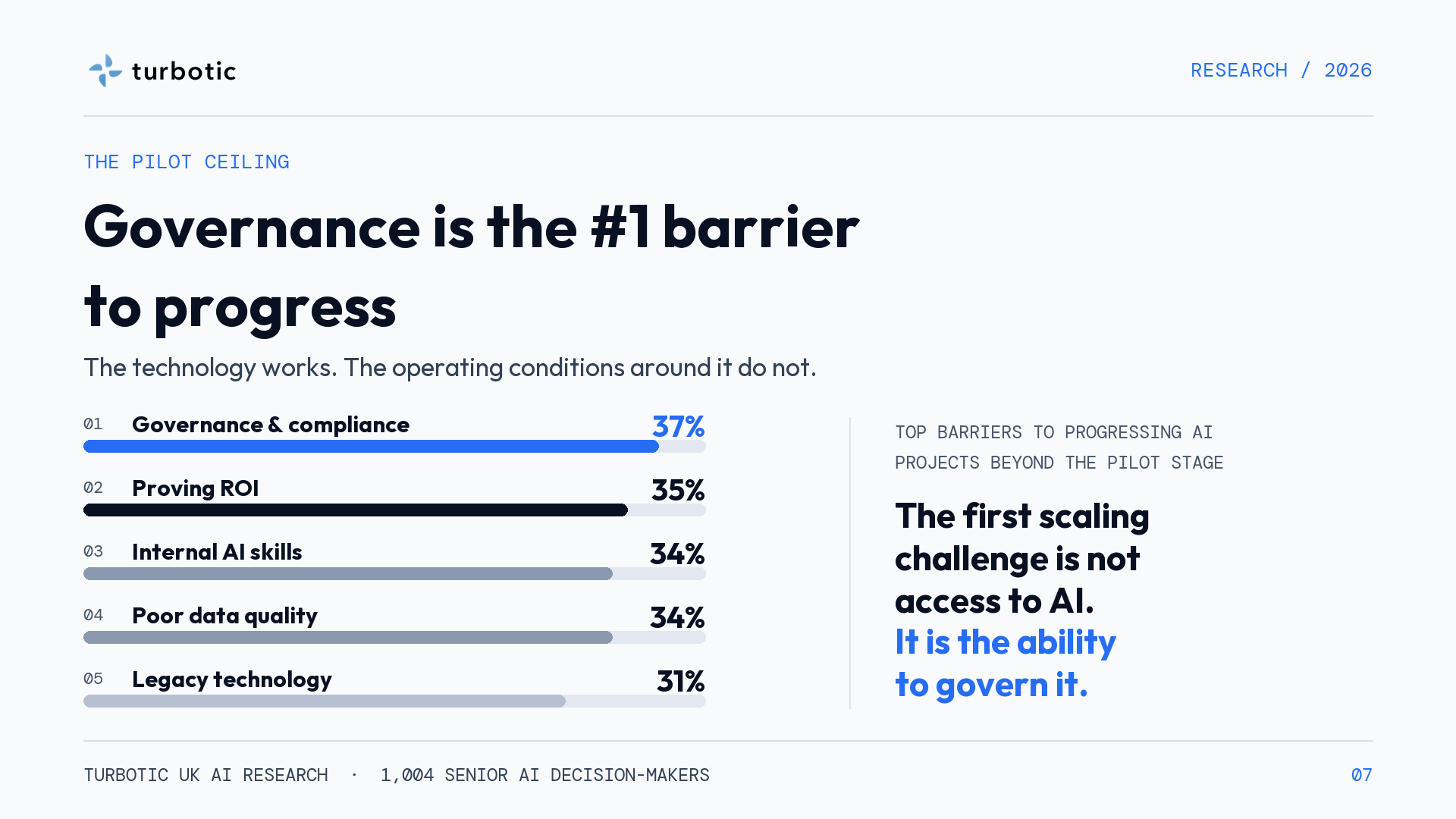
Turbotic research, surveying 1,004 senior UK decision-makers involved in setting and assessing AI projects, conducted by Research Without Barriers, 13–21 July 2026.
The governance finding challenges a common assumption. It's often treated as an early-stage or SME problem, something larger organisations have already solved. The data says otherwise: among organisations with 500 to 999 employees, 48% cite governance and compliance as their top barrier — well above the overall average.
In other words, growing in size doesn't automatically bring clarity on who owns AI, what it's allowed to touch, or who is accountable when it goes wrong.
The measurement gap behind the ROI problem
Proving ROI is the second biggest barrier — a pattern we've explored in why AI pilots don't deliver ROI — yet most organisations aren't setting themselves up to prove it.
- Just 26% define how success will be measured before every AI pilot begins.
- 32% say they struggle to measure the value of AI at all.
Without agreed success criteria from day one, every pilot ends in the same place: a demo that looks promising, and no clear basis for deciding whether to scale it, change it or stop it. That's how organisations end up with a growing portfolio of pilots and very little in production.
What gets harder once pilots are built
Getting a pilot approved is one hurdle. Scaling it is another — 37% of organisations say they struggle to scale AI once pilots are built. At this stage, the challenges shift:
- Integration with existing systems — 47%
- Lack of skills or expertise — 42%
- Securing budget — 36%
- Finding suitable use cases — 35%
- Governance and compliance — 35%
And for organisations deploying AI at scale, the biggest concerns are about control:
- Data security — 52%
- Regulatory compliance — 45%
- Accuracy of outputs — 43%
- Integration with existing systems — 37%
- Lack of human oversight — 35%
Governance doesn't disappear once a pilot is approved. It shows up again at every stage — just in a different form. For UK organisations, data protection guidance and secure AI system development guidelines are useful starting points.
What Turbotic's CEO says about it
"Governance shouldn't be something businesses add once a project is ready to scale, nor should it be positioned as something that slows AI down. Clear ownership, appropriate controls and accountability give businesses the foundations to move beyond experimentation with confidence. That also means agreeing what success looks like before a pilot begins. Yet just 26% of organisations do this every time, which makes it much harder to decide what should be scaled, what should be changed and what should simply be stopped."
— Theodore Bergqvist, CEO and Co-founder, Turbotic
Behavioral drift is the new attack surface for AI agents
Our new white paper introduces a practical framework for governing drift across models, prompts, agents and systems.
Read the white paperHow to move AI from pilot to production
The businesses that scale AI successfully treat governance as a foundation, not a final checkpoint. In practice, that means:
- Agree what success looks like before the pilot starts. Define the metrics, the baseline and the decision point upfront, so you know whether to scale, change or stop. A structured opportunity discovery process helps here.
- Assign clear ownership from day one. Every AI initiative needs a named owner who is accountable for how it performs, what data it uses and what happens when it fails.
- Build governance into the design, not on top of it. Controls, human oversight and data access rules should be part of how a pilot is built — not an audit that happens once it's ready to scale. Our automation governance framework shows what that looks like in practice.
- Plan for integration early. With 47% citing integration as their biggest scaling challenge, a pilot that can't connect to existing systems was never really on a path to production. An AI orchestration layer keeps agents, automations and systems connected and governed as you scale and operate.
- Close the skills gap deliberately. Build internal capability alongside delivery, so teams can manage and scale AI themselves rather than depending on external support indefinitely. Our free AI tools help you assess readiness and estimate ROI before you commit.
This is the gap Turbotic works with clients to close — helping organisations move from AI experimentation to operational, governed AI that delivers measurable value in day-to-day operations.
Frequently asked questions
Why do so many AI projects get stuck in the pilot stage?
According to Turbotic's 2026 research, the most common barriers are governance and compliance (37%), proving ROI (35%), a lack of internal AI skills (34%) and poor data quality (34%). The underlying issue is organisational readiness rather than access to technology.
What percentage of UK businesses are scaling AI successfully?
Only 16% of senior UK decision-makers say their organisation is deploying AI at scale successfully.
Is AI governance only a problem for smaller businesses?
No. Governance concerns are even higher among organisations with 500 to 999 employees, where 48% cite it as their top barrier to moving beyond pilots.
What is the biggest challenge when scaling AI after a pilot?
Integration with existing systems, cited by 47% of respondents, followed by a lack of skills or expertise (42%).
How can businesses prove the ROI of AI pilots?
By defining success metrics before the pilot begins. Only 26% of organisations do this every time, which makes it much harder to decide what to scale, change or stop.
About the research
The findings come from a Turbotic study surveying 1,004 senior decision-makers involved in setting and assessing AI projects at UK businesses with 10+ employees. The survey was conducted online by Research Without Barriers between 13–21 July 2026. It forms part of a wider Turbotic study into why UK businesses struggle to move AI from pilots into day-to-day operations. Earlier findings revealed that 88% of UK leaders believe Shadow AI is used in their business, with further insights to follow. The research has also been covered in the news, and our white paper on behavioral drift in AI agents looks at what governance needs to cover once agents are live.
Ready to move your AI beyond the pilot stage? Turbotic helps businesses turn AI pilots into production-ready, governed operations — with clear ownership, measurable outcomes and governance built in from day one. Get in touch to talk about where your organisation stands.